Rear-end collisions remain among the most frequent traffic accidents on modern roads. Whether navigating dense city traffic or cruising down high-speed highways, maintaining a safe gap between your vehicle and the car ahead is your primary defense against sudden stops. While many drivers rely on visual guessing, estimating safe distances in feet or car lengths is notoriously inaccurate, especially as vehicle speeds change.
The most reliable technique practiced by professional defensive drivers is learning how to measure following distance using fixed road landmarks. By combining fixed visual markers with precise time-based counting, you can maintain an optimal safety buffer regardless of your speed.
Understanding the Time-Distance Gap
Estimating distance in static units like feet or car lengths becomes ineffective as your speed increases. At 30 mph, a vehicle travels approximately 44 feet per second, whereas at 65 mph, that distance leaps to nearly 95 feet per second. Visualizing 200 feet at highway speeds while focusing on traffic is challenging for the human brain.
Time-based measurement solves this issue automatically. When you track distance in seconds rather than feet, the actual physical gap between vehicles expands naturally as speed increases. The standard baseline for dry pavement and clear weather is the 3-second rule, which provides sufficient time to perceive a hazard, react, and bring your vehicle to a safe stop.
Step-by-Step: How to Measure Following Distance Using Fixed Road Landmarks
Using physical road markers to calculate your space cushion is a straightforward habit that takes only a few seconds to practice behind the wheel.
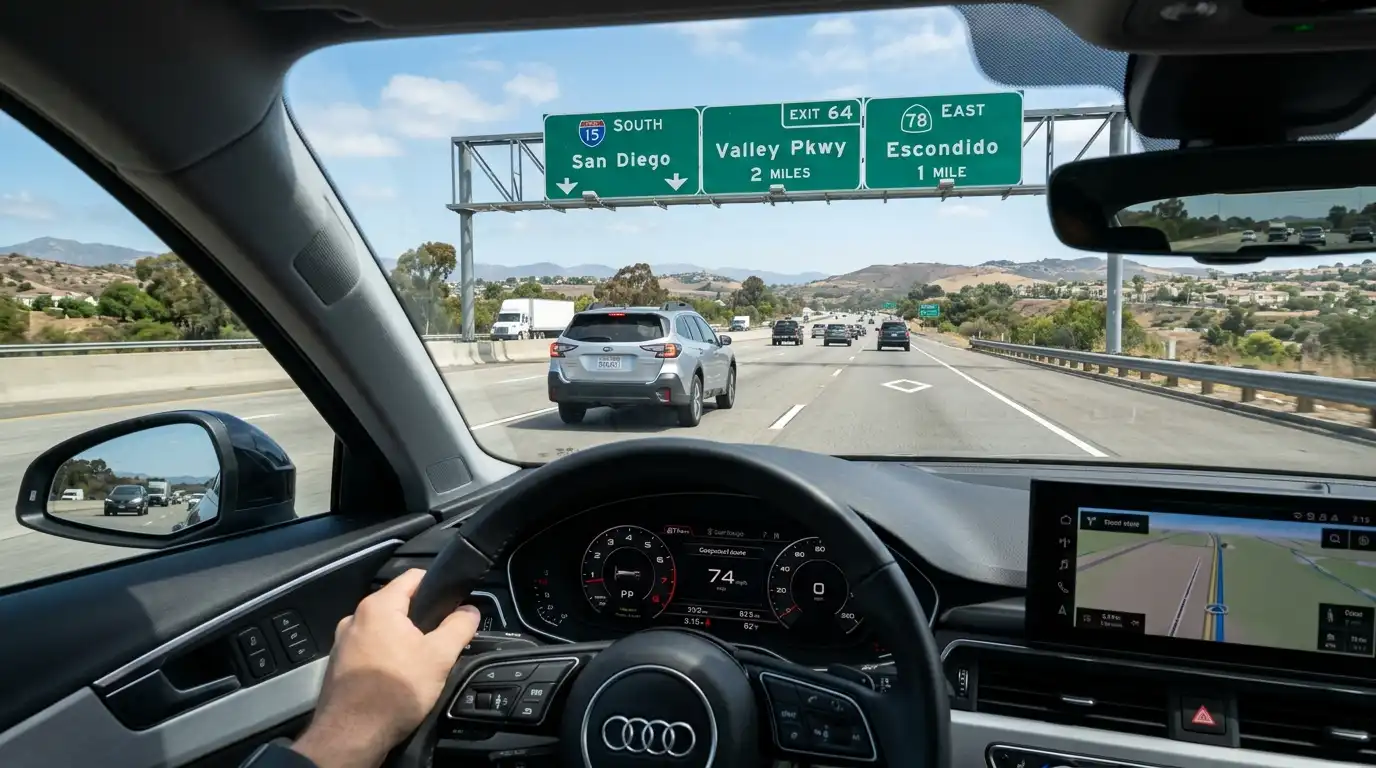
- Identify a Stationary Landmark Ahead: Look down the road at the vehicle traveling directly in front of you. Choose an easily identifiable, stationary object that the lead car is about to pass. Excellent landmarks include overhead highway signs, bridge overpasses, light poles, road signposts, or distinct shadows on the pavement. Never use a moving object, such as another vehicle, as a reference point.
- Start Counting When the Lead Vehicle Passes the Landmark: The moment the rear bumper of the lead car clears your selected landmark, begin counting seconds at a steady pace: “One-thousand-one, one-thousand-two, one-thousand-three.”
- Evaluate Your Passing Position: Note when the front bumper of your vehicle reaches that same landmark. If your front bumper crosses the landmark before you finish saying “one-thousand-three,” you are tailgating and following too closely. Ease off the accelerator to open up a larger gap.
For additional statistical data on driver reaction times and braking distance factors, review the official guidance on NHTSA Road Safety Standards.
When to Extend Your Following Distance Beyond 3 Seconds

While a 3-second gap works well under ideal conditions, real-world driving often presents environmental and mechanical variables that demand an increased cushion. In hazardous situations, extend your count to 4 to 6 seconds or more.
- Adverse Weather Conditions: Rain, snow, sleet, and ice drastically reduce tire traction. Wet roads can double your required stopping distance, while icy roads can increase it up to ten times.
- Night Driving and Low Visibility: Reduced visibility from darkness, fog, or heavy glare limits how quickly you can spot road hazards or sudden brake lights ahead.
- Following Large Trucks or Commercial Vehicles: Large semi-trucks block your forward line of sight. Extending your gap allows you to look around the truck and anticipate traffic changes further up the road.
- Towing Heavy Loads: Carrying heavy cargo or pulling a trailer significantly increases your vehicle’s total mass, requiring far greater stopping distance.
- Heavy Tailgating Behind You: If a vehicle behind you is tailgating dangerously, increase your space cushion ahead. This gives you extra room to brake gradually if needed, preventing a chain-reaction rear-end collision.
The Mechanics of Stopping Distance: Perception, Reaction, and Braking
To appreciate why landmark counting is crucial, it helps to break down total stopping distance into its three core physical components:
- Perception Distance: The distance your vehicle travels from the moment your eyes see a hazard until your brain recognizes it. For an alert driver, this takes about 0.75 to 1.5 seconds.
- Reaction Distance: The distance traveled while your physical foot moves from the gas pedal to the brake pedal. This adds another 0.75 seconds on average.
- Braking Distance: The actual distance your car travels after the brakes are applied until the vehicle comes to a complete stop.
At 60 mph, a driver travels over 130 feet during perception and reaction time alone before the brakes even begin slowing the car down. Utilizing fixed road landmarks ensures you preserve the reaction zone necessary to stay safe.
Common Following Distance Errors to Avoid
Even experienced drivers fall into subtle traps that compromise their safety margin. Keep these adjustments in mind:
- Relying on Adaptive Cruise Control Alone: While modern vehicle technology helps maintain gaps, automated systems can misinterpret sudden cut-ins or severe weather. Always monitor your spacing visually using physical markers.
- Rushing the Count: Counting too fast undermines the precision of the rule. Practice saying full phrases like “one-thousand-one” or “one-Mississippi” to keep your timing accurate.
- Closing Gaps When Traffic Merges: It is frustrating when another driver cuts into your open cushion, but closing the distance out of frustration exposes you to collision risks. Calmly ease back to restore your 3-second safety window.
Make Landmark Space Management a Habit
Consistently practicing how to measure following distance using fixed road landmarks builds instant spatial awareness. By replacing visual estimation with fixed timing methods, you grant yourself the time, space, and control needed to navigate unexpected hazards safely.